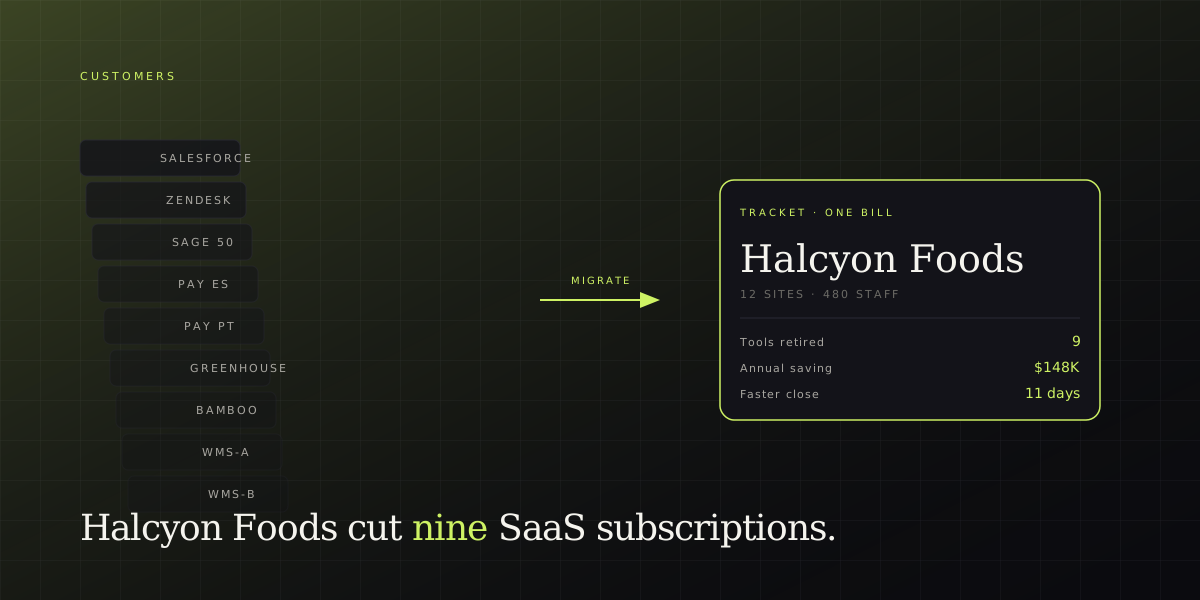
Saurashtra Foods went from one warehouse in Surat to twelve facilities across Iberia in three years. The growth was the easy part. The infrastructure underneath — eight separate SaaS products, three competing sources of customer truth, a CFO who couldn't trust her own monthly close — was a slow-motion crisis.
Hetal Bhatt, Saurashtra's COO, took us through what they were running before the migration: Salesforce-lite for sales, Zendesk for support, a desktop accounting suite for books, two payroll vendors (one for Portugal, one for Spain), a separate ATS, an HRIS, two warehouse-management tools, and a homegrown order portal that nobody wanted to touch.
The 9am Monday meeting
Every Monday at 9am, four people from the finance team spent two hours in a meeting room reconciling a single shared spreadsheet. The point of the meeting was to make four different reports — pulled from four different systems — agree. Twice a quarter, they didn't agree. Those were the bad weeks.
Every Monday at 9am, four people spent two hours making the numbers agree. Twice a quarter, they didn't.
"That meeting was the symptom," Marisol told us. "The disease was that nine systems each had their own definition of 'customer'. The customer ID in our CRM didn't match the customer ID in our books. The customer ID in our books didn't match the customer ID in our support system. We were inventing reconciliation jobs because we'd accidentally invented nine different customers."
What they replaced — and with what
The Saurashtra migration ran in four phases over six weekends, with Tracket's white-glove migration team handling the bulk of the data move. Each phase landed on Atlas as it migrated, so the duplicate-customer cleanup happened progressively rather than as a Big Bang.
- Phase 1 — CRM (replacing Salesforce-lite + lead-capture tool)
- Phase 2 — Books (replacing desktop accounting + two payroll vendors)
- Phase 3 — Desk (replacing Zendesk + WhatsApp business gateway)
- Phase 4 — People (replacing HRIS + ATS)
The order matters. CRM first means every other migration arrives with a clean, deduplicated customer list. Books second means revenue is reconciled before support cuts over and starts asking who paid. Desk third means support agents inherit context from day one. People fourth because HR is internal and lower-stakes.
The numbers, unedited
Nine SaaS subscriptions retired. $148,400 in annualized recurring savings, net of Tracket's bill. Migration cost paid back in eleven months. Monthly close compressed from 19 days to 8. The four-person Monday reconciliation meeting was deleted from the calendar. (The team kept the slot for a "what shall we automate next?" working group.)
The non-financial change was bigger. "I trust the numbers now," Marisol said. "I haven't trusted my own monthly close in three years. That's not a software win, that's a sleep win."
— READ THE FULL CASE STUDY: HALCYON · CASE →